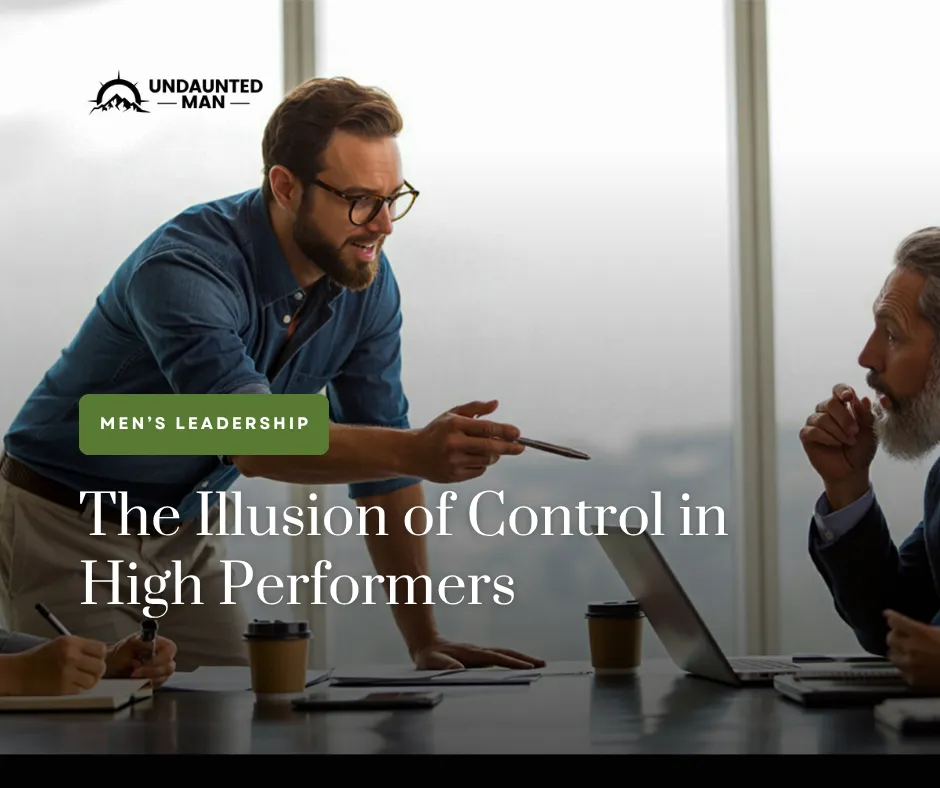
The Illusion of Control in High Performers
Control is one of the most effective tools a man develops early in his life.
It produces results. It reduces uncertainty. It creates a sense of order in environments that would otherwise feel unpredictable. For men operating in high-pressure contexts, control becomes not just a strategy, but a default.
And for a long time, it works.
The problem is not that control is ineffective.
The problem is that its effectiveness is context-dependent.
Why Control Feels Like Leadership
In structured environments, control produces efficiency.
Decisions are made quickly. Outcomes are directed. Variability is minimized.
These are all characteristics that are rewarded in professional settings, and they reinforce the belief that control is synonymous with leadership.
In many cases, it is.
But only within certain constraints.
Where Control Begins to Break Down
As environments become more complex—particularly in relational contexts—the limitations of control become more apparent.
Control requires predictability.
Relationships are not predictable.
Control requires compliance.
Relationships require engagement.
This distinction is critical, and it is often overlooked.
Leadership research in organizational performance consistently highlights the importance of adaptability and responsiveness in complex systems (see McKinsey insights on leadership dynamics).
What is less frequently acknowledged is how this applies to personal leadership.
The Cost of Over-Reliance on Control
When control becomes the default, it narrows perspective.
It reduces the ability to engage with nuance. It limits the capacity to adapt to variables that cannot be managed through force or direction.
Over time, this creates rigidity.
Not in a way that is immediately visible, but in a way that affects how decisions are made and how interactions are experienced.
You will see how this impacts relationships in Why Your Marriage Feels Off.
The Shift From Control to Leadership
Leadership, in its more developed form, requires the ability to operate without relying on control as the primary mechanism.
It requires influence rather than force.
It requires engagement rather than direction.
This is not a rejection of control, but a recalibration of when and how it is used.
Executive Self-Leadership Calibration
Discernment is not something most men have ever measured.
The Self-Leadership Assessment provides a clear view of how you are currently making decisions—particularly under pressure and in the absence of clear external structure.
Confidential. Direct.
Take the Self-Leadership Assessment → https://theundauntedman.com/quiz


