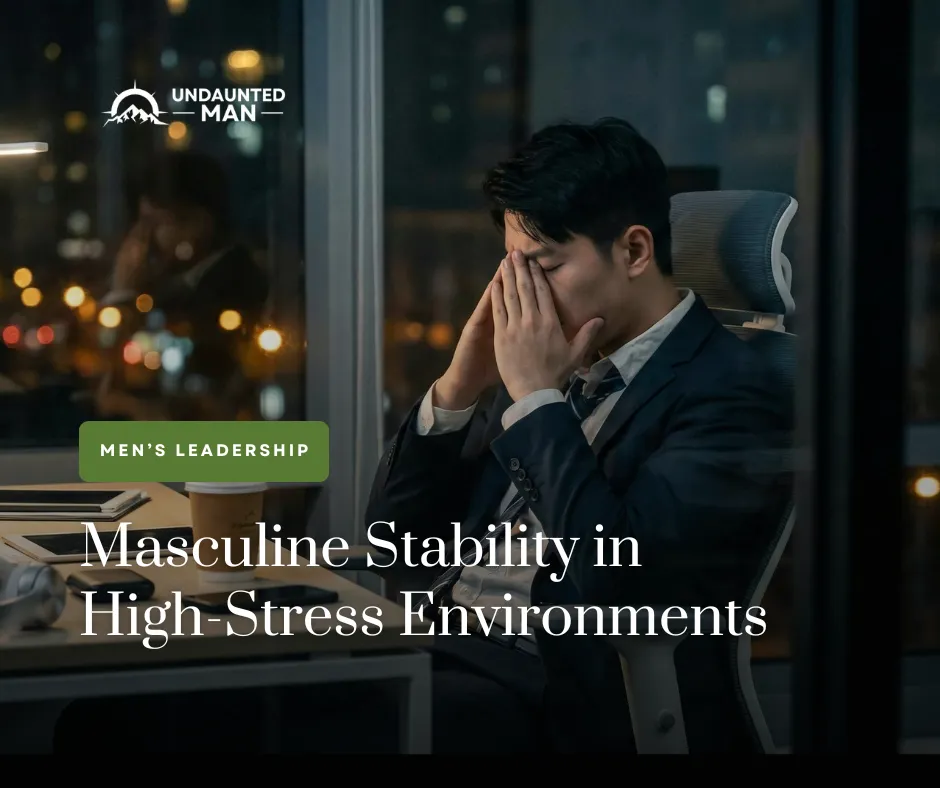
Masculine Stability in High-Stress Environments
High-stress environments reveal structure.
They do not create character; they expose it.
For men in executive roles, stress is constant. Financial exposure, personnel decisions, legal risk, competitive volatility — these are ordinary conditions. The professional system is built to metabolize pressure.
Relational systems are not.
Masculine stability in high-stress environments refers to the ability to prevent external pressure from becoming internal volatility that leaks into private domains.
The American Psychological Association outlines how stress responses narrow attention, increase reactivity, and reduce impulse control (https://www.apa.org/topics/stress). These effects are physiological. They are not signs of weakness.
The question is behavioral translation.
Does stress sharpen your decision-making? Or does it shorten your patience?
The Misalignment Between Professional and Personal Stress
In professional contexts, controlled aggression can be productive. Deadlines compress thinking. Competition demands urgency. A degree of forcefulness produces clarity.
In intimate relationships, the same urgency destabilizes conversation.
If the nervous system remains activated after leaving work, small relational friction can be interpreted as obstruction rather than dialogue.
The high-performing man often believes he is simply being efficient.
The partner may experience him as unavailable or abrupt.
Stability requires conscious transition.
Without transition, stress migrates.
The Spillover Effect
Stress spillover occurs when activation generated in one environment affects behavior in another.
It manifests subtly:
Reduced tolerance for ambiguity.
Shortened conversational bandwidth.
Impatience with emotional processing.
Withdrawal framed as exhaustion.
Over time, this spillover reshapes relational patterns.
Conversations become more transactional. Emotional range narrows. Humor decreases.
The executive may attribute relational drift to workload.
The underlying mechanism is unregulated carryover.
Stability as Containment
Stability does not require the elimination of stress.
It requires containment.
Containment in this context means holding stress internally long enough to metabolize it rather than discharging it through tone, correction, or retreat.
This is not suppression.
Suppression accumulates and eventually erupts.
Containment processes and releases deliberately.
Men who fail to develop this capacity often oscillate between over-control and withdrawal.
Men who develop it maintain behavioral consistency across domains.
Observable Markers
Masculine stability in high-stress environments can be assessed through consistency:
Does your tone remain stable when fatigued?
Does your pace remain measured when under deadline?
Does your partner notice mood shifts correlated with professional setbacks?
If external volatility produces internal behavioral fluctuation, stability is conditional.
Conditional stability undermines trust.
Development
Professional systems often incentivize stress tolerance without teaching stress processing.
Peer environments that normalize overextension reinforce the pattern.
Structured men’s groups provide an alternative context where stress patterns are examined directly rather than rationalized.
This is part of the calibration inside Undaunted’s Executive-Level Men’s Groups.
Explore further:
https://theundauntedman.com


