Men Aren't Silent Out of Shame. They Know the Price of Speaking.
"Just be vulnerable" doesn't miss that price. It bills them for it.
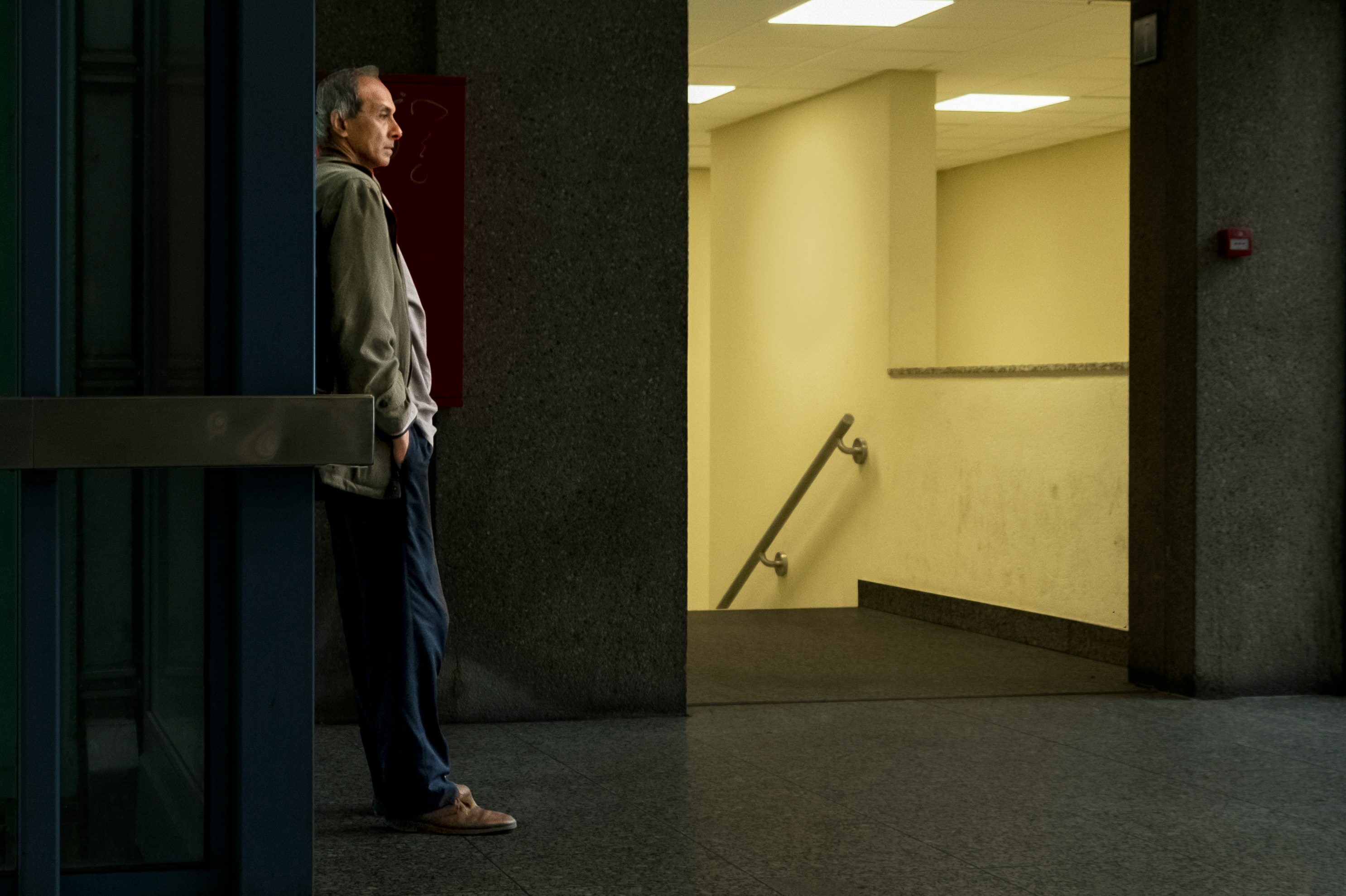
A man drives ninety minutes to sit with me for an hour and spends fifty-two minutes of it on a decision he made three weeks ago. Then he stands, gets his coat on, puts a hand on the doorframe, and says the real thing in about nine words. Then he apologizes for saying it. Then he's in the parking lot before I've finished a sentence.
I used to read that as shame. It isn't. He wasn't ashamed of what he said. He was pricing it. He'd run the numbers on that sentence long before he walked in, decided it cost more than it returned, and let it out only at the door, where the exposure lasts nine seconds instead of an hour. That's not damage. That's arithmetic, and he's good at it, and he's been running it since he was maybe eleven.
I want to be exact about what I'm claiming, because the soft version of this subject is everywhere and it's useless.
The test
A legitimate need is one whose absence shows up in a man's conduct whether he admits it or not.
Needs leak. That's the whole test. Go without and it comes out sideways — in contempt for people who haven't earned it, in the numbness he calls being level-headed, in the third drink that was never really about the drink, in the fight he picked with his son over a dish, in the flat gray stretch he's learned to call contentment. He doesn't decide to leak. He usually doesn't notice. The people around him notice first and misfile it as personality.
Wants don't leak. Go without a want and you're fine, and — this is the part that makes the test usable — you know you're fine.
Now let me run it against something I claimed for years.
I used to say I needed to be understood. It sounded true. It felt true at the time I was saying it. But I've had long stretches where nobody around me had any accurate picture of what I was doing or why, and I came through those stretches without leaking anything. No contempt, no numbness, no compulsion. Being unexplained cost me nothing I can find. What leaked, when something leaked, was never the absence of understanding. It was the absence of any hour where I wasn't the one holding the thing up. Those are different needs and I had them confused for most of a decade. Being understood is a want. A good one. I'd like it. Nothing in me breaks without it.
The test cut me before I ever pointed it at anyone else. That's the only reason I trust it.
And the point of any of this is fulfillment — mental, physical, spiritual, a life that's actually good and not merely defensible. But fulfillment is the destination. It's not the ruler. You can't measure a need by whether its absence makes you unhappy. Plenty of things make a man unhappy that he could go without forever. The ruler is the leak.
Why he goes quiet
Men compartmentalize because it works.
Not because someone trained us into it, not because of a defect we inherited. It works. Set the thing down in its box, close the box, do the work in front of you, open the box later or never. The results are good enough, often enough, that the habit is rational.
And there's a harder observation underneath it. What people say they want from a man and what they respond to in a man are two different measurements, and they diverge. I've watched that divergence run for forty years — in rooms I was leading, on trips I was guiding, at retreats where men had nowhere to put their faces. It isn't hypocrisy. Almost nobody knows it's happening in themselves.
But the distinction everything here depends on is narrower than that, and I need it stated exactly right, because the loose version of it has done real harm:
What people withdraw from is not a man who feels. It's a man who can't hold what he's holding.
Disclosure from capacity reads as strength. The same words, from a man who is visibly at the end of his rope, read as a request to be carried — and everyone within ten feet smells the difference in about a second. They can't articulate it. They don't need to. The response is already moving before the thought arrives.
Which is why the thing men actually offer, when they offer anything, isn't vulnerability at all.
A man who has learned this can only speak once the thing is handled. Once the diagnosis is in and the treatment worked. Once the business survived the quarter. Once the fear turned out to be unfounded, or turned out to be founded and he absorbed it anyway. What he brings back isn't an open wound. It's an after-action report from the far side. Clean, sequenced, resolved. He tells you about the eight weeks he thought it was over, and he tells you in the past tense, and everyone in the room is moved, and nothing was ever at risk in the telling because there was nothing left to risk by the time it was told.
He still held it alone. He always holds it alone. The report is proof of that, not an exception to it.
So here is the claim, stated so it can be attacked: unresolved disclosure by a man is priced. The price is levied by nearly everyone, including — especially — the people who sincerely insist they don't levy it. And men learn the exchange rate early, well before they could explain it.
What would show me wrong: evidence that unresolved disclosure by men in ordinary settings — work, friendship, marriage — is met neutrally or well across the board. Not the exceptional friend. Not the one boss in twenty. Across the board. If the price isn't real, there's no essay here and I'd have to say so and stop writing it.
Where the rooms went
There's a history to this and it has no villain in it. I want to walk it carefully, because the version with a villain is more satisfying and less true.
Stage one. The household economy put a boy beside his father inside the work. Not in a designated hour. In the work — the field, the shop, the forge, the ledger. Competence was witnessed daily by the people it fed, and incompetence was witnessed the same way. That's the whole claim I'm making about it. Proximity and witnessed competence. Nothing more.
That world was hard, dangerous, and often short. It was not a place where men wept in front of their sons and I have no evidence that it was. Anyone selling you a lost Eden is selling. What industrialization did was pull the man out of the house for nearly all his waking hours into conditions that were, by every account we have, miserable — and it took the proximity with him. The boy stopped seeing the work. He saw a man arrive at night, spent.
Stage two is the part people don't know, and it's the more interesting part, because men noticed the loss and did something about it.
Roughly 1870 to 1920, men built replacements on purpose and at enormous scale. Lodges. Fraternal orders. Degrees, ordeals, ritual, older men who conferred something on younger men in front of other men. Millions of them. Working men paying dues they felt, in buildings they put up themselves, to sit in rooms with an architecture of obligation and initiation deliberately designed.
These were prosthetics. That's not a slight — a prosthetic is a serious piece of engineering. But they were doing on purpose what had previously happened without anyone deciding it should, and a thing you have to decide to do is more fragile than a thing that just occurs.
Then they died too. The Depression took the dues. Insurance companies and then the state absorbed the mutual-aid functions that had been half the practical reason to join. Suburbanization moved men away from the halls. Television made the evening cheaper to fill. Professions credentialized and the informal ladder of older men stopped mattering to a young man's career. People started moving every few years and a lodge is a bet on staying.
Nothing came back at that scale. The Masons counted just over four million American members in 1959 and fewer than nine hundred thousand by 2023, against a population that nearly doubled in between. These aren't orders that died. They're orders that shrank by nine-tenths measured against the number of men alive, which is the same outcome arriving slowly enough that nobody had to watch it happen.
No designer. No design. Institutional collapse is usually overdetermined and authorless, and I've come to think that's a harder truth than sabotage, not a softer one. Sabotage implies a saboteur, and a saboteur can be beaten. Nobody did this. It came apart under a dozen unrelated pressures, most of them things we'd have chosen anyway.
Some of it held. The Knights of Columbus still runs fifteen thousand councils. Something like six hundred thousand men still answer a volunteer fire siren for no money. There are gyms where men fail in front of each other four nights a week and think nothing of it. Those are real rooms and I'd send a man to any of them.
Now look at what each one asks at the door. Be Catholic. Be willing to walk into a burning house for someone you have never met. Be willing to get choked unconscious by a stranger on a Tuesday. Every container still standing charges admission in a currency most men don't hold, and the ones that ask least — the ones that will take anyone — mostly want a diagnosis or a war or a wrecked life first. Bring a problem and there's a room for you. Bring nothing but yourself, at forty, tired, with no creed and no siren and no interest in fighting, and there is no door with your name on it.
That's the loss. Not that the rooms all vanished. That the price of the ones left is high enough to filter out almost every man who needs one and hasn't broken yet.
What a container actually is
A container is not a place where a man talks about his life.
It's a place where he is not load-bearing for a few hours.
That's the whole specification, and almost nothing meets it. He can talk all he wants in most rooms and still be the beam holding the ceiling up — still managing the temperature, still watching what his disclosure is costing the person hearing it, still doing the calculation. The talking isn't the thing. The setting down is the thing.
That's what the ordeal was for. Not toughness. A threshold where a man was permitted to fail in front of witnesses whose regard for him did not depend on his succeeding — and everyone in the room had already been through it, so no one was impressed and no one was appalled.
Therapy comes closest and is disqualified twice: I pay, so the room exists exactly as long as I keep funding it and not one week longer — and nothing runs the other direction, because the man across from me will never need me, never fail in front of me, and never owes me an hour.
That's a description of the mechanism, not a verdict on the practice.
The exhibit
I'll stop describing and be the exhibit.
What follows is a composite. It's mine and it's also four other men's, and I've moved the particulars — the room, the hour, the year — because the one person who could be identified by them never agreed to appear in anything I write. What I have not moved is the arithmetic. That part is exact, in my case and in theirs, which is most of why I trust it.
It was a Tuesday, and late — after eleven, the house quiet, both of us in the kitchen because that's where the light was still on. I had been carrying something for about five months that I had not said out loud to anyone. Not a crisis. A slow, grinding thing about work and money and whether I had judged something badly at the start of it.
I was standing at the counter with my back to the room, and I said: "I don't know if I can keep doing this, and I don't know what I'd do instead."
Present tense. Unresolved. No plan attached. It cost me more to say those two clauses than anything I'd said in that kitchen in fifteen years, and my hands were flat on the counter the whole time because I didn't trust what they'd do otherwise.
Then the room changed temperature.
I want to be precise, because precision is the only thing I have here. Nothing was said that I could put in this essay. Nobody left. Nothing was withdrawn that I could name, point to, or complain about. Something cooled — that's the honest unit of measurement. I've never asked.
It took a bit over three weeks to come back to whatever it had been before, and it did come back, fully, and the life around it has been good since.
Somewhere in the middle of those three weeks, standing in the same kitchen on a different night, I decided I would not pay that again.
That was eleven years ago. I've not spent it again.
Here's what I owe the reader: I know what that was. Not because I asked — I never have. Because I've run it since, deliberately, in rooms and relationships where I wasn't at the end of anything and chose to look like I was. I wanted to know whether the cooling tracked the weakness or tracked something else. It tracks the weakness. It has tracked the weakness every time, in my own house and in the accounts of men who arrived at the same three weeks independently and had no word for it either.
What changed that Tuesday wasn't a response to weakness in the abstract. It was a response to a man who had always been the floor announcing, at eleven at night, that he wasn't sure the floor held. Those aren't two things. The second is what the first looks like from across a kitchen.
I don't know what any of it looked like from the other side of that counter, and I'm not entitled to say. I know what the room did. I've known since well before I stopped testing it.
One more thing about that doorframe, and I'd be dodging if I left it out. Forty years of rooms, trailheads, and last nights of retreats, and I've heard the door sentence — the one a man says with his coat already on, or with the truck already running — more times than I've counted. Most of the time it's about a woman. Usually a wife. Sometimes his mother, thirty years on.
That's not a finding about women and I won't convert it into one. It's a finding about where men put everything. He deposits his entire account in one relationship, tells no one else the balance, and then does the arithmetic on his one available withdrawal and discovers the rate is brutal — which it would be, at that concentration, from anyone. The complaint version of this observation is sitting right there, free, and any man can pick it up this afternoon. Every man I've watched pick it up stopped building that same week. It explains everything and it requires nothing, which is what makes it so restful, and I have never once seen a man come back from it with a room.
Why "just be vulnerable" is worthless
Because it prescribes an act and withholds the room the act needs to survive in.
That's the counsel I'm against, and it's the only adversary in this essay. It tells a man his disclosure will be met without penalty. It reads his hesitation as fear when the hesitation is arithmetic and the arithmetic is usually right. It bills him for the gap between the promise and the result, and then calls the damage a failure of nerve.
It's advanced sincerely, by men and by women, mostly by people who would be genuinely sick to see the invoice. It isn't a conspiracy and it isn't a sex. It's a set of claims that keeps getting repeated because the first half of it is true and nobody checks the second half.
Vulnerability isn't weakness. That was never the problem. The problem is that it's a load transfer, and a load transfer requires something on the other end rated to take the load, and for most men in most of their lives there is currently nothing there. Telling a man to jump is not the same as building the net. And nobody is coming to build it. Not the counsel that prescribed the jump. Not anyone.
What's left
Which leaves construction.
Men are doing it. Right now, quietly, in small numbers, in a thousand places that will never be famous — four men who meet on a Thursday and have for six years, a garage, a fire pit, a Saturday morning with no agenda beyond showing up, a room where the rule is that nobody fixes anybody. Most of them have no name for what they're doing. Some of them are barely holding it together. It doesn't matter. The specification is met: for a few hours, nobody in there is the beam.
Mine is one of them, and I do want it to be the model. Not because it's mine. Because I've watched this particular structure hold under weight, repeatedly, with men who had every reason to quit it, and I'd rather a man copy something that works than improvise something that doesn't and conclude the whole idea was soft. Take the structure. Run it in your town. Don't ask me first. If yours outlasts mine, the purpose is served and I'll have lost nothing worth keeping.
Build it small. Build it with men whose regard for you doesn't move when you fail in front of them, and be that for them first, before you need it. Meet on a schedule so that showing up isn't a decision anyone has to make while carrying something. Keep it going long enough that the ordinary Tuesdays outnumber the hard ones, because that's the only way anyone learns it's safe.
That's constraint, chosen, and it's the only kind that makes a man free. It's also the entire reason The Undaunted Man exists. I run men's groups — the same men, twice a month, facilitated, going as long as a man keeps showing up. Some meet in a room. Some meet on a screen, because there are men reading this who don't have four other men within an hour of them, and geography is a stupid reason to go without. The virtual ones give up proximity. That's a real loss and I won't pretend otherwise. What they keep is the part that does the work: the same men, and a date nobody has to decide on. Three or four times a year we run the Silent Summit, and twice a year the Inner Compass. Those are the threshold — the part no twice-monthly room, in person or otherwise, can give you.
And yes, there's a fee, and you should have caught that, because I just spent a paragraph telling you payment disqualifies a room. Here's the difference and it's the whole difference. The fee buys the facilitation and the night on the calendar. It does not buy the other men. They aren't paid to be there. They need the room as much as you do, and by the third month you'll be holding it for one of them without having decided to. That's mutuality, and no amount of money manufactures it — it either shows up in the room or it doesn't. The price moves and there are scholarships, so if money is the thing standing between you and the door, say so and we'll handle it. A room whose price screens out the men who need it worst is exactly the room I just spent this essay against.
Come sit in one before you decide anything: theundauntedman.com/groups. The first is free and I'd rather you walk out than be talked into it.
And if you'd rather build your own — build it. Write to me when it breaks. I read what comes in.
Nobody is coming to build it.
Build it.


